
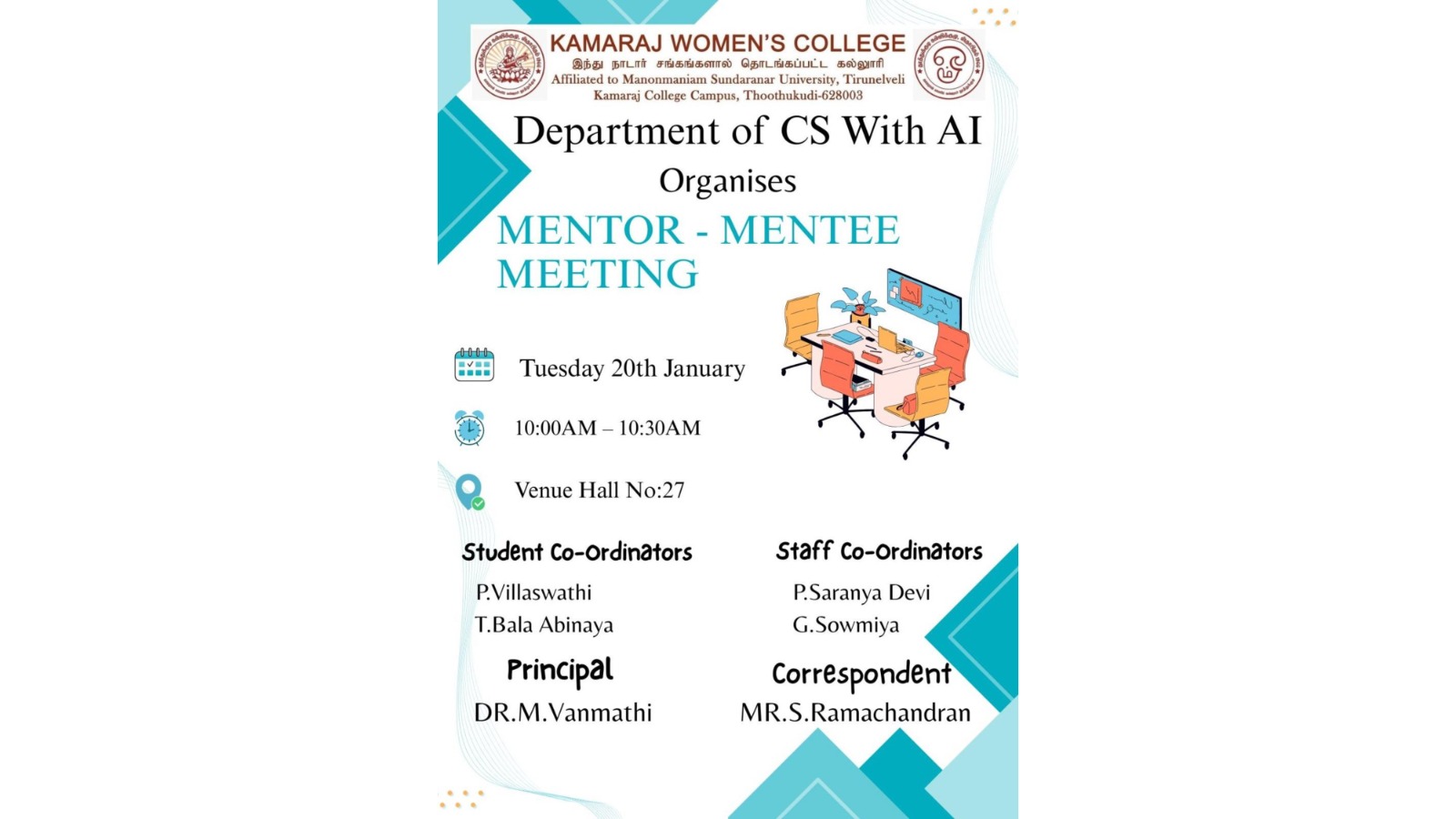
Transformative Mentor – Mentee Meeting | Academic Excellence in Action

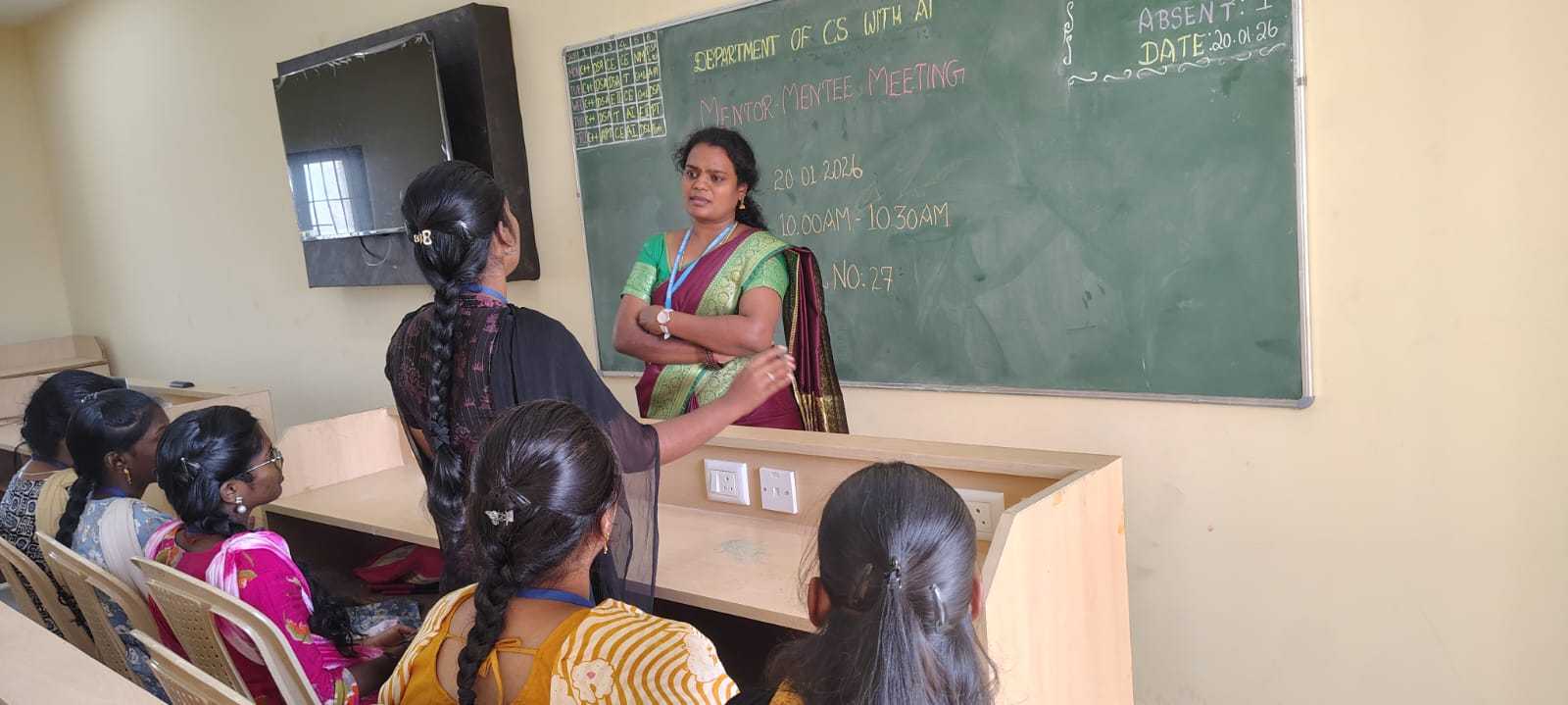
Mentor – Mentee Meeting
The Department of Computer Science at Kamaraj Women’s College conducted a structured and purposeful Mentor – Mentee Meeting as part of its continuous academic monitoring and student support system. This meeting was organized to review the internal assessment performance of students, particularly in Artificial Intelligence (AI) and related subjects.
Moreover, the session aimed to create a supportive academic environment by identifying learning challenges and implementing effective strategies for improvement. Faculty members, class advisors, and mentors actively participated in the meeting to ensure comprehensive discussions and evidence-based decision-making. As a result, the department reaffirmed its commitment to academic excellence and student success.
Objectives of the Meeting
The primary objectives of the Mentor – Mentee Meeting were clearly outlined and systematically addressed. These objectives included:
- To review and analyze internal assessment marks obtained by students across AI-related subjects.
- To identify academically weak or at-risk students requiring additional support.
- To understand the reasons for low academic performance, if any.
- To propose corrective and supportive measures to enhance student outcomes.
- To strengthen mentoring and monitoring mechanisms within the department.
Through these goals, the department ensured that the meeting remained focused, constructive, and student-centric.
Discussion on Internal Assessment Performance
During the meeting, faculty members presented the internal assessment marks and conducted a detailed analysis. Initially, the overall performance trends were reviewed to identify patterns across different student groups. Subsequently, students were categorized as high-performing, average, or low-performing based on their scores.
Furthermore, faculty compared current assessment results with previous performances to track academic progress. In addition, subject-wise and unit-wise analyses helped identify specific areas of difficulty. Common challenges were observed in topics such as:
- Algorithm design and implementation
- Data handling and processing techniques
- Model interpretation and evaluation in AI
Faculty members also shared observations related to student attendance, classroom participation, assignment submission, and practical performance. Consequently, these factors were found to be directly linked to students’ internal assessment outcomes.
Key Academic Issues Identified
Based on the detailed discussions, several academic concerns were identified that required immediate attention. These issues included:
- Lack of conceptual clarity in core subjects, particularly in AI-related topics.
- Inadequate practice in programming and problem-solving exercises.
- Irregular attendance among a few students, affecting continuity of learning.
- Poor time management and exam preparation strategies.
Although these challenges varied among students, the department recognized the importance of addressing them collectively and proactively.
Measures Taken to Improve Academic Performance
After thorough deliberation, the department proposed and approved several supportive measures to enhance students’ academic performance. These strategies were designed to be both remedial and developmental.
- Remedial Classes Special tutorial and remedial sessions will be conducted for slow learners, with a strong focus on difficult concepts and foundational topics.
- Additional Practice Sessions Hands-on laboratory sessions and structured coding practice hours will be increased to strengthen students’ practical understanding.
- Enhanced Mentor–Mentee Interaction Mentors will engage in regular interactions with students to monitor academic progress, attendance, and learning challenges.
- Assignment and Test Support Frequent internal tests, quizzes, and guided assignments will be implemented to promote continuous learning and build confidence.
- Peer Learning and Group Discussions Collaborative learning activities and group discussions will be encouraged to improve conceptual understanding and peer support.
Through these measures, the department aimed to create a structured support system that fosters academic growth and confidence among students.
Role of Faculty and Mentors
The success of the Mentor – Mentee Meeting was largely attributed to the active involvement of faculty members and mentors. They not only analyzed academic data but also provided personalized guidance to students.
Moreover, mentors committed to maintaining continuous communication with mentees. This approach ensures early identification of academic challenges and timely intervention. As a result, the department strengthened its mentoring culture and reinforced its student-centric academic framework.
Academic and Institutional Impact
The meeting significantly contributed to enhancing the department’s academic monitoring system. By adopting data-driven strategies and collaborative problem-solving, the department ensured that no student was left unsupported.
In addition, the Mentor – Mentee Meeting aligned with the institution’s broader goals of academic excellence, holistic development, and continuous quality improvement. Furthermore, such initiatives directly support the institution’s vision of nurturing competent, confident, and socially responsible graduates.
Conclusion
In conclusion, the Mentor – Mentee Meeting conducted by the Department of Computer Science at Kamaraj Women’s College was a constructive and impactful academic intervention. Through detailed performance analysis, issue identification, and the implementation of supportive measures, the department reinforced its commitment to student success.
Ultimately, the meeting strengthened the mentoring framework, improved academic monitoring, and promoted a culture of continuous improvement. The department remains dedicated to guiding students toward academic excellence and professional competence.
🔗 Useful Links
Internal Link:
Kamaraj Women’s College – Official Website
External Link:
AICTE – Artificial Intelligence in Education