
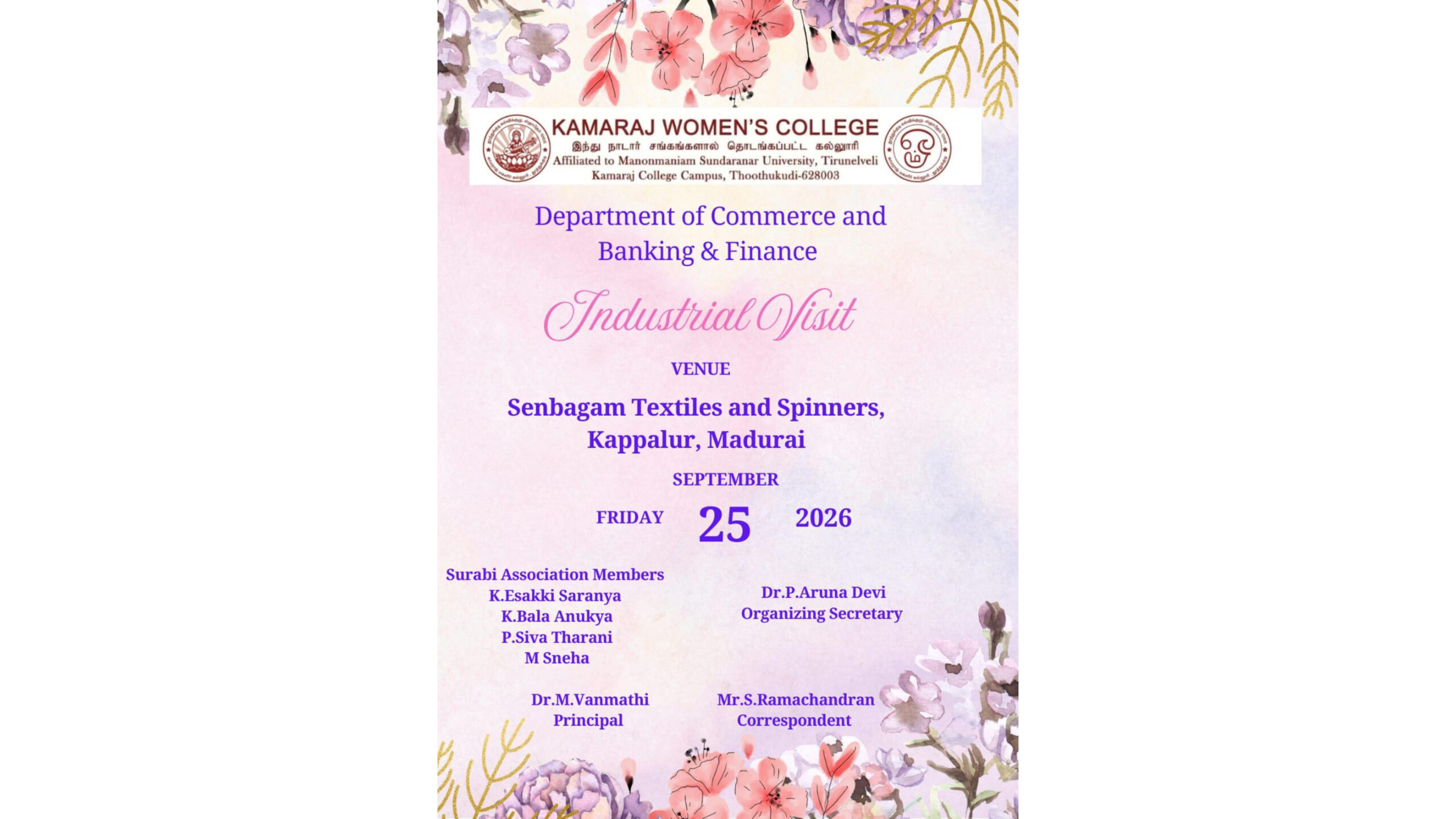
Textile Industrial Visit Gives KWC Students Practical Exposure
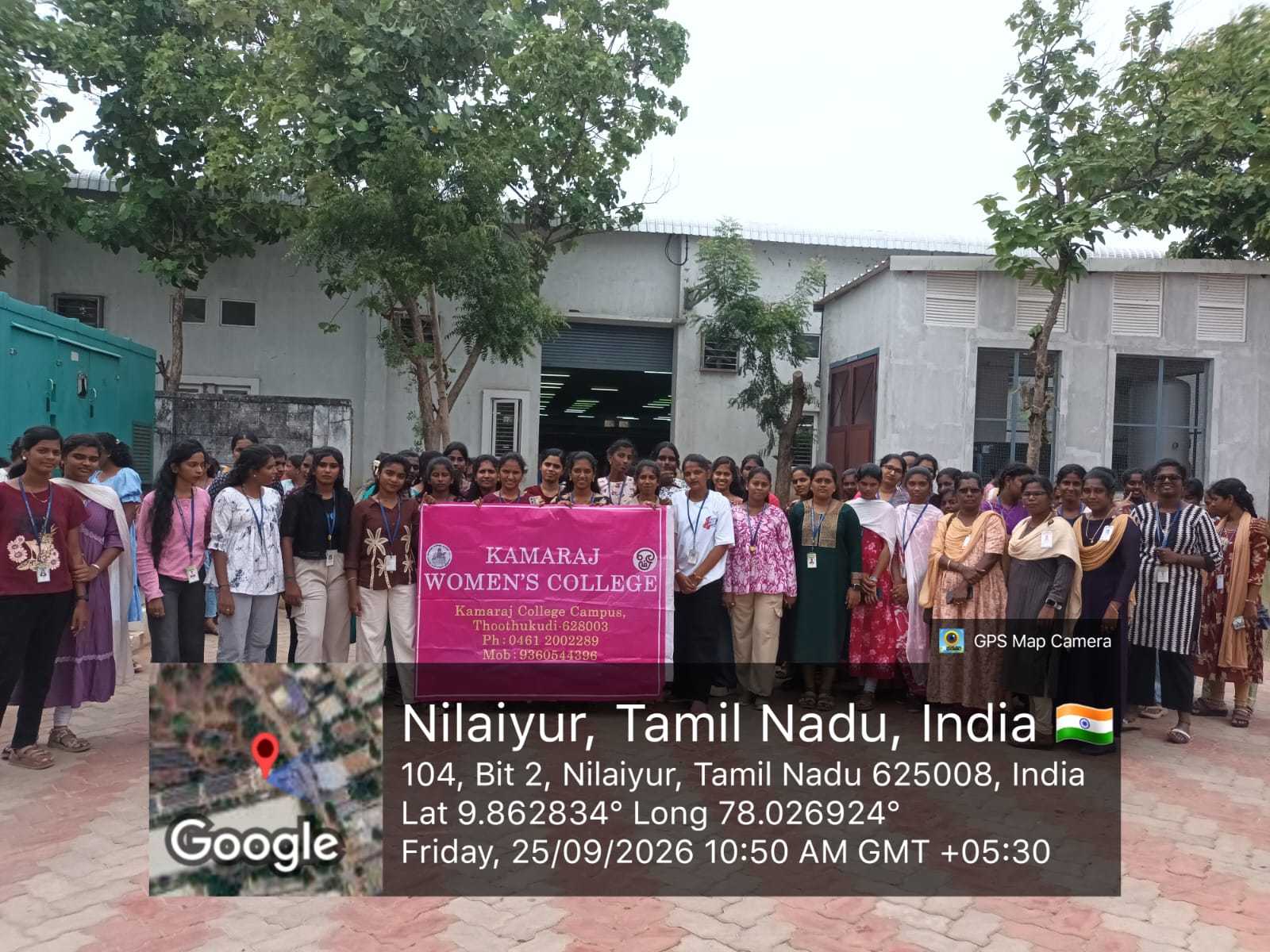
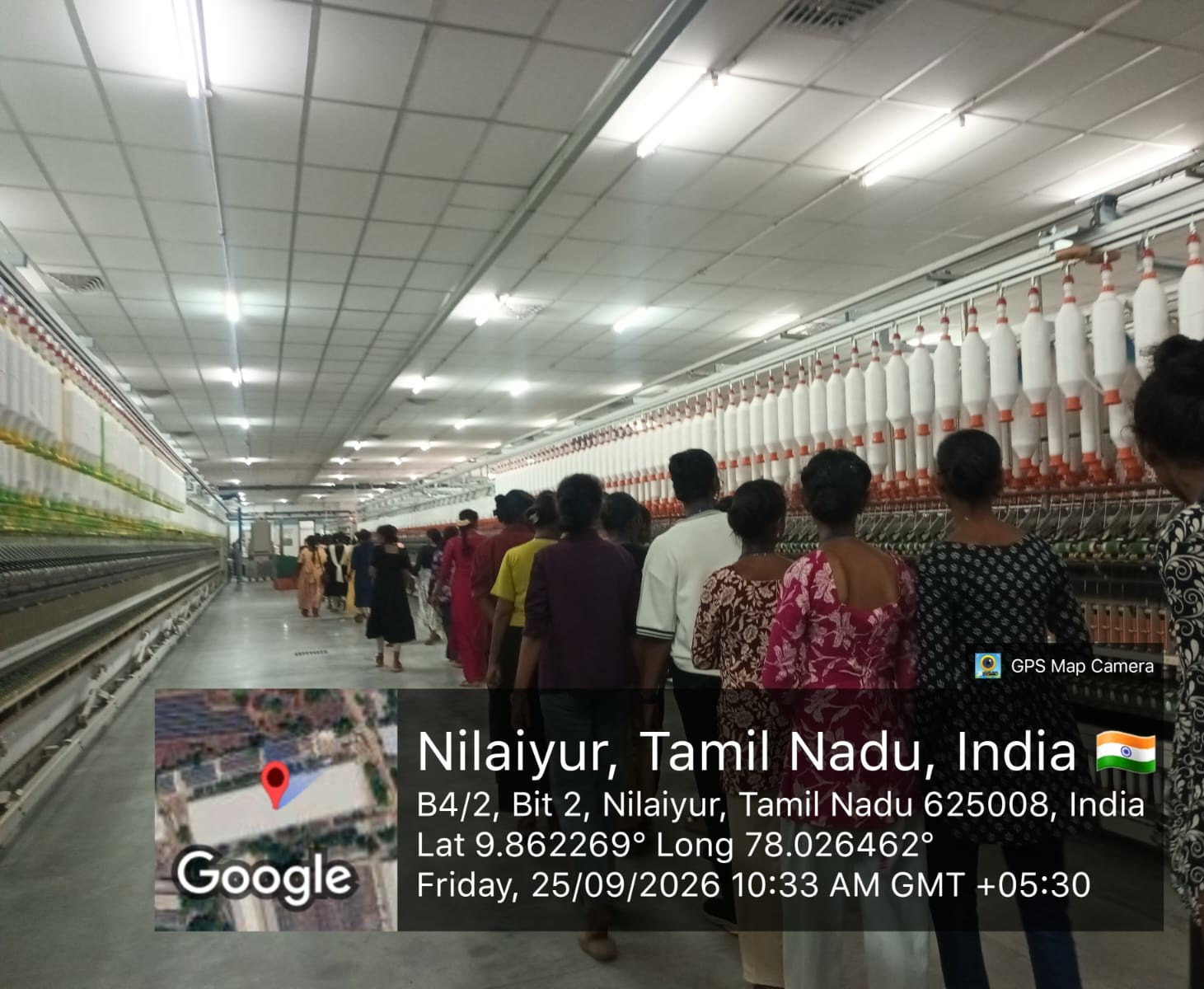
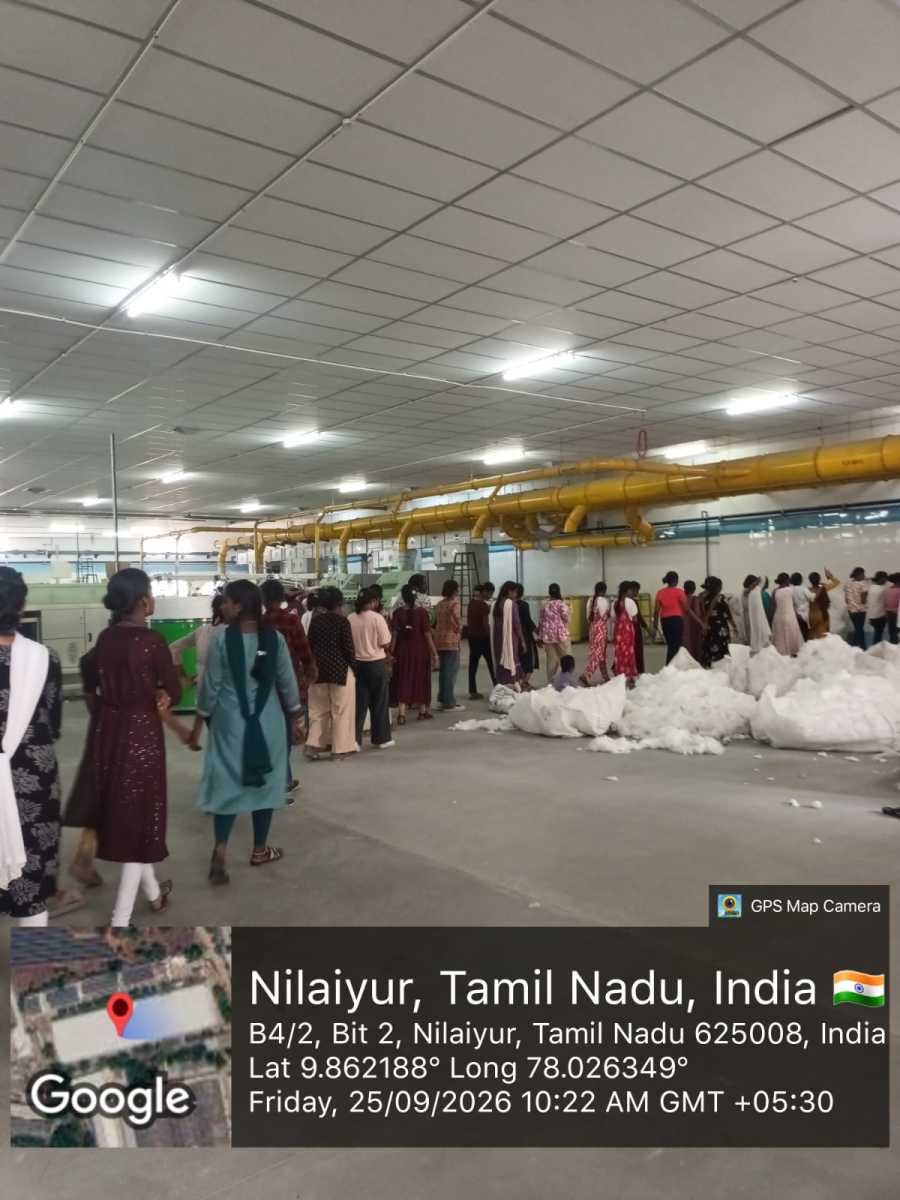
Report on Textile Industrial Visit
The Department of Commerce and Banking & Finance, Kamaraj Women’s College, Thoothukudi, organized a Textile Industrial Visit to Senbagam Textiles and Spinners, Kappalur, Madurai, on 25 September 2026. The visit aimed to provide students with practical exposure to the functioning and operations of the textile and spinning industry.
During the visit, students observed different stages of the production process and gained first-hand knowledge of industrial operations. Moreover, the visit helped them connect classroom concepts related to production, costing and industrial management with their practical applications in an industrial environment.
Objectives of the Textile Industrial Visit
The visit focused on the following objectives:
- Provide practical exposure to textile and spinning operations
- Help students understand different stages of production
- Introduce students to modern machinery and production techniques
- Connect classroom concepts with industrial practices
- Develop practical understanding of process costing
- Create awareness about factory maintenance
- Explain the importance of labour management
- Create awareness about employee welfare measures
- Help students understand the opportunities and challenges in the textile sector
Thus, the visit combined academic learning, industrial exposure and practical business knowledge.
Visit to Senbagam Textiles and Spinners
The students visited Senbagam Textiles and Spinners at Kappalur, Madurai, and gained direct exposure to the working environment of the textile and spinning industry.
They observed how an industrial unit manages different stages of its operations. Furthermore, the visit gave them an opportunity to understand how various functions work together to support production.
This practical exposure helped students look beyond textbook concepts and understand their application in an actual industrial setting.
Understanding the Production Process
An important part of the Textile Industrial Visit focused on understanding the production process.
Students observed various stages involved in converting raw materials into finished textile products. As a result, they gained a clearer understanding of how production activities progress through different stages within the industry.
Moreover, this exposure helped students relate their academic knowledge of production and management to practical industrial operations.
The visit therefore provided a useful link between theory and application.
Modern Machinery and Production Techniques
Students observed the use of modern machinery and advanced production techniques during the visit.
They gained practical knowledge about how machinery supports different stages of spinning and textile manufacturing. In addition, they understood how modern production methods help industries improve output and operational efficiency.
The visit also allowed students to see how technology forms an important part of present-day industrial operations.
Thus, they gained a broader understanding of the relationship between technology, production and efficiency.
Learning About the Spinning Process
The visit introduced students to different stages associated with spinning and textile manufacturing.
They observed the production environment and gained practical knowledge of how textile operations take place within an industrial unit.
Furthermore, this exposure helped students understand the systematic nature of industrial production.
For Commerce and Banking & Finance students, the experience offered a practical perspective on how manufacturing activities connect with business operations and management.
Understanding Process Costing
The visit also strengthened students’ understanding of process costing.
Students could relate their classroom knowledge of costing to a production environment where manufacturing takes place through different stages.
Moreover, the industrial setting helped them understand why businesses need to monitor costs throughout the production process.
This practical exposure made the concept of process costing more relevant and easier to connect with real industrial operations.
Factory Maintenance
Another important area of learning was factory maintenance.
Students observed the importance of maintaining machinery and production facilities for the smooth functioning of industrial operations.
Furthermore, the visit helped them understand that regular maintenance supports continuous production and efficient use of industrial equipment.
Thus, students gained awareness of how maintenance forms an important part of overall industrial management.
Labour Management and Employee Welfare
The students also gained exposure to labour management and employee welfare measures.
The visit helped them understand the role of workforce management in supporting industrial operations. Moreover, they learned that effective coordination between employees and management contributes to the smooth functioning of an organization.
Students also gained awareness about the importance of employee welfare within an industrial environment.
Therefore, the visit expanded their understanding beyond production and introduced them to the human side of industrial management.
Connecting Commerce with Industrial Operations
The Textile Industrial Visit was particularly useful for students of Commerce and Banking & Finance because it connected several academic concepts with practical industrial activities.
Concepts such as production, costing, management, workforce coordination and operational efficiency became easier to understand when students observed them in an industrial environment.
Furthermore, the visit demonstrated how different business functions support the overall operation of a manufacturing organization.
As a result, students gained a broader perspective on the practical application of commerce-related subjects.
Learning Beyond the Classroom
The industrial visit created a valuable learning opportunity beyond the regular classroom environment.
Students gained direct exposure to industrial practices instead of learning about them only through textbooks. Moreover, they observed how technology, people, costing and management work together within an industry.
This experience helped students develop a more practical understanding of the concepts covered in their academic programme.
Therefore, the visit effectively complemented classroom teaching with industrial exposure.
Awareness of the Textile and Spinning Sector
The programme also helped students develop greater awareness of the textile and spinning sector.
They gained insight into the working environment, production activities and management practices associated with the industry.
In addition, the visit helped them understand some of the opportunities and challenges connected with industrial operations.
Such exposure can help students develop a wider understanding of different sectors while considering their future academic and professional paths.
Learning Outcomes
The Textile Industrial Visit provided the following learning outcomes:
- Students gained practical exposure to textile and spinning operations
- They understood different stages of the production process
- Students observed modern machinery and production techniques
- They developed a better understanding of process costing
- Students learned about the importance of factory maintenance
- They gained awareness about labour management
- Students understood the importance of employee welfare measures
- The visit connected classroom concepts with industrial practices
- Students developed awareness of industrial management and operational efficiency
- They gained a broader understanding of the textile and spinning sector
Overall, the visit strengthened students’ understanding of production, costing, technology, maintenance and workforce management in an industrial setting.
Conclusion of the Textile Industrial Visit
The Textile Industrial Visit to Senbagam Textiles and Spinners, Kappalur, Madurai, provided students of the Department of Commerce and Banking & Finance with an informative and enriching learning experience.
Students gained direct exposure to industrial operations, modern production technology, process costing, factory maintenance, labour management and employee welfare. Moreover, the visit helped them connect theoretical concepts with their practical application in an industrial environment.
The programme also gave students a better understanding of the textile and spinning sector while broadening their awareness of industrial practices.
Overall, the visit successfully bridged the gap between classroom learning and practical industrial exposure and contributed to the students’ academic and professional development.